Greenwashing at COP30: ‘The bill is coming’
Millions invested in infrastructure and events at COP30, all of which supposedly champion ‘sustainability,’ masked the interests of economic groups responsible for destroying the Forest at the planet’s largest climate event
Hyury Potter, Guamá River, Belém, Amazon
While tens of thousands of people occupied the streets of Belém to ask for climate justice at the Climate March on November 15, a few kilometers away a group was discussing cutting CO2 emissions, one of the causes of global heating. A natural topic for a climate summit, if not for one detail: the debate was being led by Petrobras, the very same company that 20 days prior to COP30 began to drill another exploratory oil well in the Foz do Amazonas region, an extremely biodiverse area – a decision made counter to the “transition away from fossil fuels” agreed upon at COP28, in Dubai.
One speaker, the president of the Brazilian Institute of Oil and Gas and a former Petrobras executive, Roberto Ardenghy, started by referring to the “highly qualified” people who were there to hear about the wonders of fossil fuels in the Cumaru auditorium – a Brazil Pavilion space, like the Sumauma auditorium, which was named after a tree and featured some panel discussions on polluting activities that are being sold as “green.”
Ardenghy went straight to the point and connected the burning of oil to the generation of wealth: “It’s impossible to imagine an opulent, rich, comfortable society that doesn’t have high energy consumption, and therefore oil,” said the president of the institute lobbying on behalf of the oil industry. And he was not alone in his mission. According to a survey published by the Kick Big Polluters Out coalition, over 1,600 fossil fuel lobbyists were given credentials to take part in climate negotiations at COP30. If they were a country, the oil group would be the second largest delegation at the conference, trailing only Brazil with its group of 3,805 delegates.
Demonstrators were still out on Avenida Duque de Caxias, some falling ill under the blazing sun, when Fernanda Diniz, a decarbonization manager at Petrobras, spoke in an air conditioned room about “a better carbon footprint” and “ethics,” while saying nothing about the peoples who will be affected by drilling. “Decarbonization isn’t just an ethical issue, but also one of competitiveness. The ones who brought a portfolio, a resilient oil, will be capable of playing the game in the future,” said the Petrobras manager. At the March for Global Climate Justice happening right next door, protestors held a funeral for oil. And Luene Karipuna, the executive coordinator of the Articulation of Indigenous Peoples and Organizations of Amapá and Northern Pará was calling attention to a lack of any consultation of Indigenous peoples before a license was granted to drill in Foz do Amazonas and about the threats leaders receive.
The greenwashing, the “green” marketing used by the companies destroying the Amazon, was apparent in the corridors and around the climate conference. Among coffees and croutons, cheese and wine, deals were cut on the corporate “green future,” which involves continuing to profit from Nature, while behind the scenes more ambitious rules to save human life on the planet-home were prevented from being approved. In the Blue Zone, the scene of the official climate summit negotiations, one of the most popular places for corporate representatives to visit was the National Confederation of Industry pavilion, a space split between chairs to sit and watch two simultaneous screens and tall tables for informal business talks.
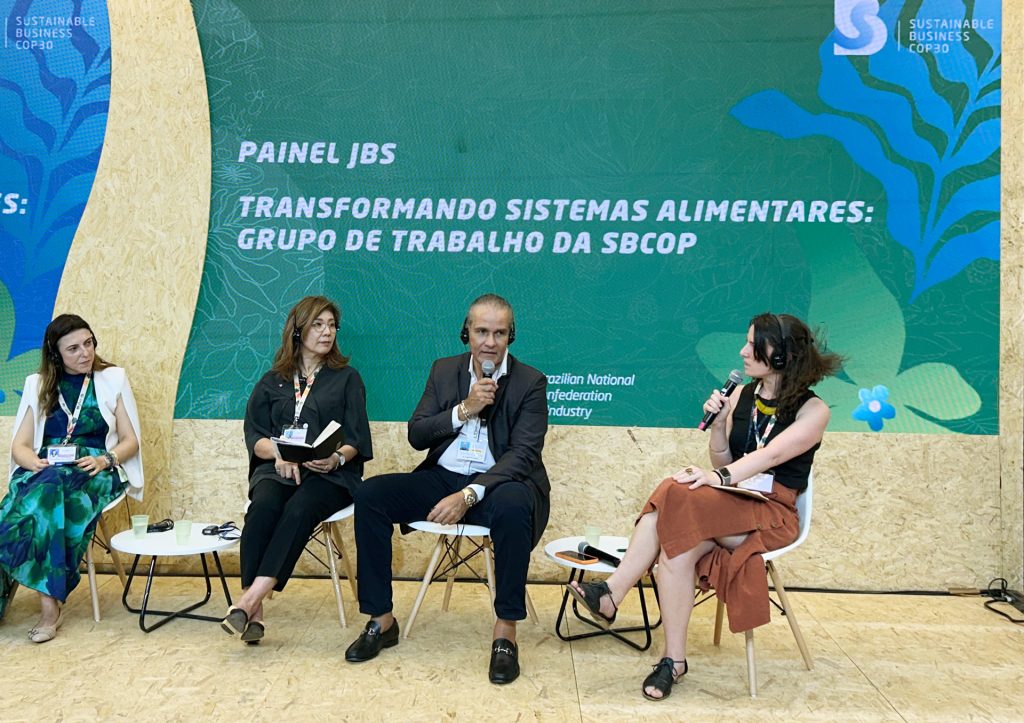
At one roundtable discussion held by JBS, the world’s largest meat producer, Renato Mauro Menezes Costa, the president of Friboi, one of the companies under the JBS umbrella, talked about solutions for more “sustainable” production. The Green Offices program was among the proposals, which advises partner livestock farmers on environmental regularization and provides technical and managerial assistance. According to the executive, a tall man with tan skin and neatly brushed hair wearing a shiny pair of loafers, the initiative is a hit and can be found in 11 states where the company operates.
The next day, the program included a COP sustainable business award, promoted by the National Confederation of Industry. In recent years, however, JBS has been linked to meat purchased from areas connected to illegal deforestation as well as to Indigenous territories. According to a recent investigation by the NGO Greenpeace, from 2018 to 2025, JBS supposedly purchased 2,856 cows from a farm that was allegedly part of a scheme to triangulate illegal cattle raised in the Pequizal do Naruvôtu Indigenous Territory, in eastern Mato Grosso, one of the states where the company applies its Green Offices program. The Greenpeace report says JBS responded that “all purchases mentioned in the investigation complied with company policy and industry protocol.” The company did however say that it had “preventively blocked” the farm implicated in the cattle laundering scheme. It is worth recalling that in 2024, JBS had the most tax exemptions among companies connected to agribusiness: the corporate behemoth was spared from paying 6.4 billion reals to the Brazilian government.
Munduruku warriors fight greenwashing
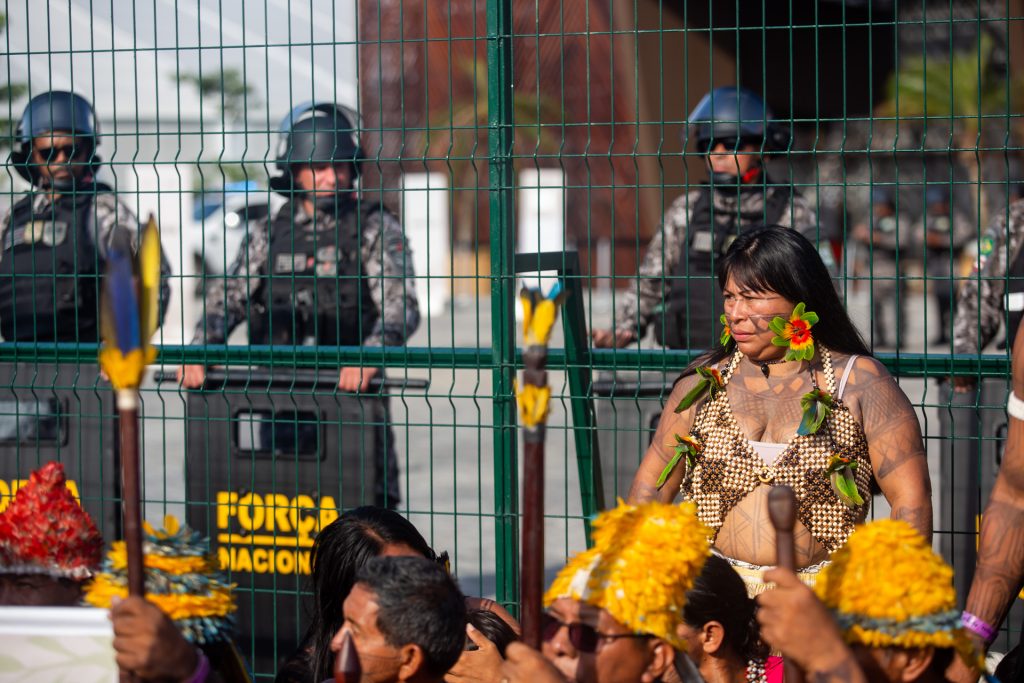
The sky was overcast on Friday, November 14, when Alessandra Munduruku boarded one of the two buses parked in front of the COP Village, both of which held around 100 Munduruku warriors. They departed punctually at 4:40 AM and in just over 15 minutes the two buses had traveled five kilometers to the area near the COP30 Blue Zone. They walked the last three blocks, with women, children, and men holding bows and arrows and carrying banners decrying the abuse suffered in Pará’s Tapajós River Basin. The Indigenous people point out how this river was “privatized” through a government decree from Lula that could turn it into a waterway for soybean distribution.
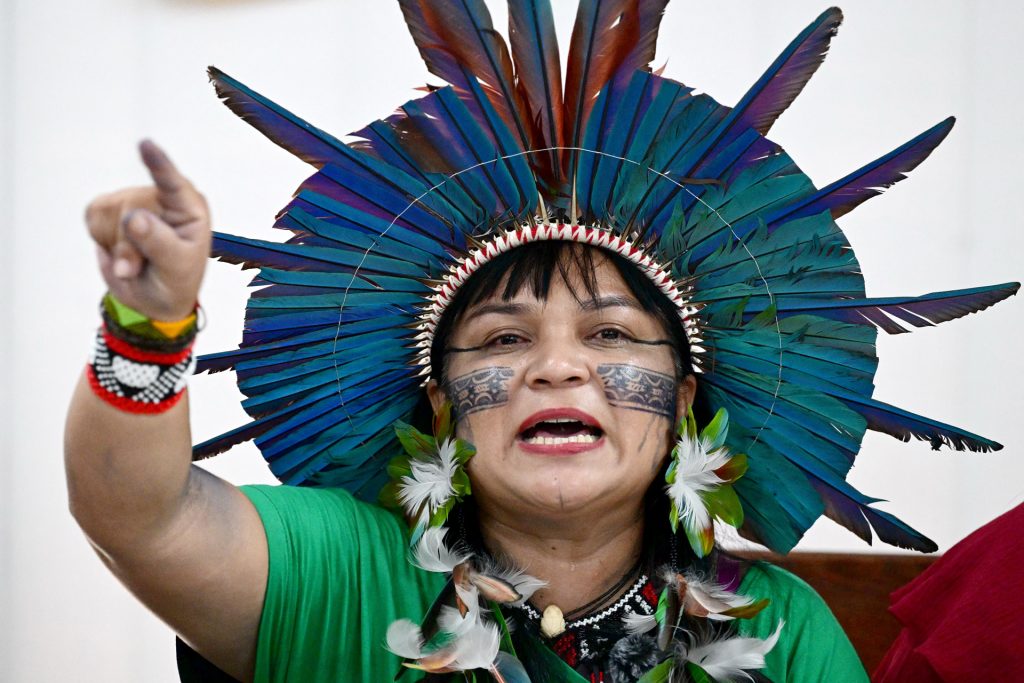
After determinedly making it through the COP’s security barrier, Alessandra, standing 1.5 meters tall and still half-asleep, grew in stature, organizing two defensive columns of men. From the median, she made her first speech about the protest, a cry that had been muffled since the start of the conference, calling out companies and countries that use Indigenous peoples for their greenwashing. “Enough of using our image to say you’re sustainable,” the Munduruku leader said.
Before the morning ended, Alessandra and her Munduruku people would also meet with Brazil’s environment and climate change minister, Marina Silva, and the Indigenous peoples minister, Sônia Guajajara, as well as André Corrêa do Lago, the COP30 president. While they were talking, the schedule of corporate events started in the Blue and Green Zones. One, a panel at the Legislative Assembly of Pará pavilion entitled “The power of sustainable prospecting,” was being moderated by a representative from this legislative body, Wescley Tomaz (Avante party), an advocate for illegal mining in Itaituba, a city where he was previously a city council member. The Green Zone is an area of the COP that is open to the public and used for networking, demonstrations and exhibitions by uncredentialed members of business groups and civil society.
At the event, held inside the space funded by Pará’s lower house of congress, he said the only “environmental crime in the Amazon” is the list of mining requests that go unapproved by the federal government. For over ten years, the Oswaldo Cruz Foundation has been doing studies in the Tapajós region and has already identified serious health problems among the Munduruku people caused by mercury contamination. Mercury is a metal used to separate gold in illegal mining operations and studies indicate that it may be responsible for children being born with birth defects.
Yet not all the discussions happening in the public space of COP30 over these two weeks were very public. Some of the large corporate groups who set up pavilions in the Green Zone preferred to try to hold discussions in secret. To enter the stand run by Deloitte, a consulting and auditing company headquartered in the United Kingdom, with offices worldwide, you had to have an additional registration, even though it was in the open Green Zone area. Journalists also had to wait for the company’s press office to authorize them.
SUMAÚMA visited one stand that discussed the “sustainability” of business and the “environmental resilience” of companies. An explanation was given on how consultants help their clients to adapt to the climate-related financial disclosures required in the United Kingdom. It was a relaxed conversation, in which the panel members’ optimism stood in contrast to the scientists lamenting the lack of progress in official negotiations.
None of the information discussed on the panel was confidential, yet during the talk, a Deloitte employee tried to remove SUMAÚMA reporters from the room, because she said the “press couldn’t remain in this space.” We stayed in the area and later sent an email asking the company for an explanation. At the time this story went to press, we had yet to receive a response.
An agribusiness party
It wasn’t just on the walls of Parque da Cidade, in the Blue and Green Zones, that the companies played their self-cleansing game. Esfera, a group that brings together executives and politicians at events, organized a corporate events center on Avenida Nazaré, in an upscale area of Belém. A mansion was adapted to welcome 700 people. There are two stages for talks, along with nine rooms for more private meetings. Partners include Chinese automaker BYD and Bradesco bank, which held a breakfast on Tuesday, November 18, in the guest space. Variations on Pará’s cuisine were served during the events, along with light beverages. Guests were given a copy of a magazine entitled “COP30 in Topics,” produced by the Esfera group and the Brazilian Institute of Education, Development and Research, a founding partner of which is Federal Supreme Court justice Gilmar Mendes.
Those visiting the manse at number 482 on Avenida Nazaré will not find a property boasting art nouveau architecture, but will rather see a glass and MDF panel with a blue banner. The façade of the over 100-year-old house, a property given protected heritage status by the National Institute of Historic and Artistic Heritage and which welcomed executives and politicians like brothers Helder Barbalho (Pará’s governor) and Jader Barbalho Filho (Lula’s minister of cities), was completely disfigured without federal government authorization, according to an embargo issued on October 7.
The embargo also shows the Esfera group’s lack of respect for Brazilian laws on the protection of heritage properties. In September, the group at one point requested permission for the changes, but this request was denied by the National Institute of Historic and Artistic Heritage in early October. A team from the heritage institute inspected the locale on October 24. An official order dated November 12 shows the Esfera group shrugged off the denial and continued to make changes to the heritage property, which has been protected since 1985.
When asked, the National Institute of Historic and Artistic Heritage told SUMAÚMA that it “did not authorize the interventions made to the property,” which is why it “embargoed the work site.” According to the federal agency, the administrative process moved in relation to the property is currently in the stage of assessing “the amount of the fine for damages caused” to the mansion used by the Esfera group.
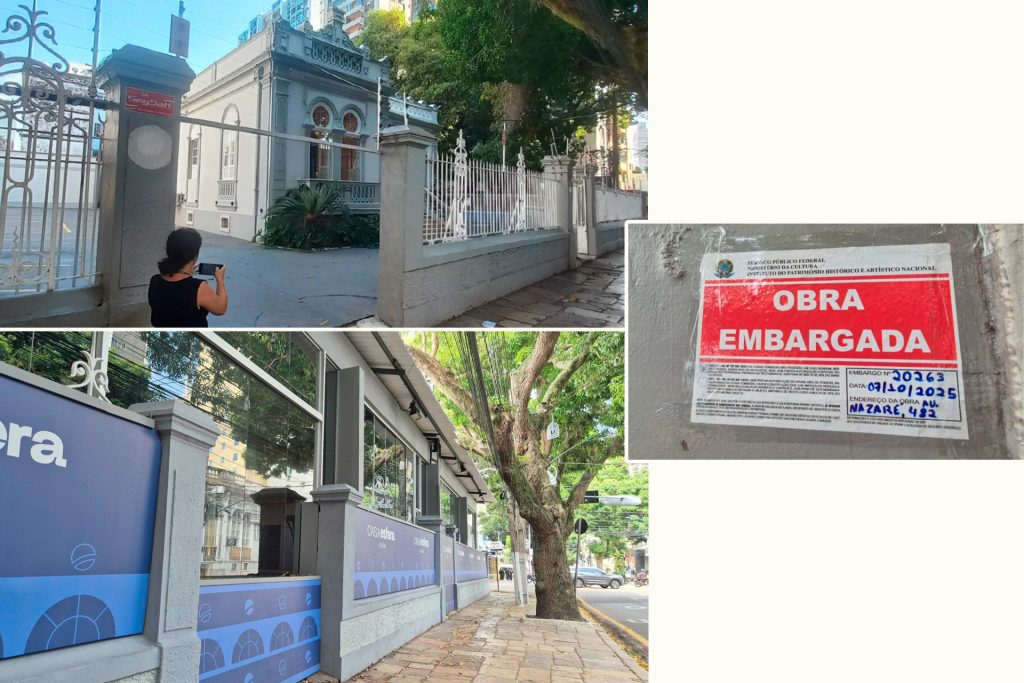 The Esfera group ignored an Iphan embargo and made changes to a protected property, making it into a center for business events at COP30. Images: Inspection report/Iphan
In a statement, the Esfera group said it “will fully comply with the legal and contractual obligation to return the property exactly in the original conditions.” Regarding its failure to comply with the National Institute of Historic and Artistic Heritage embargo, the company said it “reaffirms its statutory commitment to strict compliance with legislation and to the preservation of the country’s historical, cultural, and aesthetic heritage.”
According to Transparency International Brazil, the agriculture industry, led by the National Confederation of Agriculture, made sure at least 30 of its members were among the Brazilian delegation at the COP. This was not, however, enough for the agenda they had prepared for the entire conference period. The industry bankrolled the Agrizone, a space set up by the government’s rural research agency Embrapa, turning it into a bunker for its greenwashing. Feeling at home, the executives did not insist on using the same discretion applied to meetings in the Blue Zone pavilions, for instance, and they also switched canapés and wine for grilled meats and a steady stream of beer and samba music on Monday evening, November 17
During the day, Embrapa released a document reiterating industry positions, such as that livestock farming “can be part of the solution to combat climate change.” According to studies by the Climate Observatory’s Estimated Greenhouse Gas Emissions System, livestock farming is the economic activity that most emits greenhouse gasses in Brazil, accounting for 51% of emissions, a total of 1.1 billion metric tons of CO2 equivalent (GtCO2e) – a type of calculation that takes into account various gasses that cause the greenhouse effect and impact the climate. According to the Climate Observatory, if Brazilian cattle were their own country, it would be the world’s seventh largest emitter, ahead of Japan (1.068 GtCO2e).
At COP, the industry argued for “low-carbon livestock farming” and stated a desire to use a different way of calculating emissions than the calculation used by the federal government’s Climate Plan – Mitigation. The vice president of the National Confederation of Agriculture and president of the Agriculture Federation of the South, Gedeão Silveira Pereira, made an unceremonious speech at the end of the panels, to be followed by a feast of grilled meats, in which he attacked the federal government:
“I came here to this COP to defend us from our own, people who, financed by them [foreigners], come here to denigrate the image of Brazilian ag,” the executive said. He continued his speech by proposing a thorough scrubbing of the industry’s image: “We are the planet’s solution.”
This “solution” does not include new territories for the peoples of the Forest. During COP30, the federal government announced the certification of four Indigenous Territories and a decree declaring ten other territories. The next week, the National Confederation of Agriculture filed a motion to suspend with the Federal Supreme Court, arguing that the demarcations create “social instability” until the court considers Law 14.701/2023, which establishes a cut-off date of October 5, 1988, the date of the Federal Constitution’s enactment, as a criterion for demarcating new Indigenous Territories.
Marta Salomon, a senior specialist with the Talanoa Institute, is critical of the reaction from sectors that insist on climate denialism. “Many of those working against the climate agenda still do not understand that it costs less to shift to a low-carbon and resilient economy than to deal with the impacts of a hotter planet. The cost of inaction is much higher,” she says.
The festival of grilled meats was the cherry on an agenda filled with authorities since the doors opened to the Agrizone, which over the previous days had welcomed federal deputies Arnaldo Jardim (Cidadania party, representing São Paulo), the vice president of the Agricultural Parliamentary Front, and Alceu Moreira (Brazilian Democratic Movement, representing Rio Grande do Sul), the president of the Biodiesel Parliamentary Front. Agriculture and livestock minister Carlos Fávaro was also in attendance, telling the press, between a hunk of meat and swig of beer, that he would not be giving any interviews that evening.
In a statement published before the start of COP30, the National Articulation of Agroecology criticized the space, pointing out that it represents a “corporate seizure of the climate agenda.” The memo put out by the organization, which joins state and regional networks, as well as social movements at the national level, mentioned the “sponsorship by the Confederation of Agriculture and Livestock of Brazil and by companies like Nestlé and Bayer, multinationals that produce ultraprocessed foods and agrochemicals.”
Throughout the night, the attendees, who were dressed in jeans, shoes or boots, with some wearing shirts inscribed with “Brazil Cattle,” enjoyed samba classics, including O Bêbado e o Equilibrista, by João Bosco and Aldir Blanc. Sticking out among the industry execs who were all smiles and speaking loudly were two uniformed employees wearing State Agriculture Inspection vests. These are the people who would the next day inspect farms owned by the people at the party.
 Agriculture minister Carlos Fávaro attended the party held by the livestock industry inside the Agrizone during COP30. Photo: Fernando Martinho/Repórter Brasil
The omnipresent Vale and Hydro
On the way from the airport to Parque da Cidade, it is impossible not to pass an advertising billboard or space financed by the Vale and Hydro mining companies. The park holding the Blue and Green Zones cost nearly 1 billion reals, paid for in Vale offsets. And the company also transferred funds from the Mining Resources Oversight Fee to build Porto Futuro 2, where the Museum of the Amazons is exhibiting the photographs of Sebastião Salgado. “There is a very big effort by these companies to try to convey an environmentally correct image. Everyone arriving at the airport in Belém passes several billboards for mining as well as agribusiness companies,” according to Renato Morgado, a program manager with Transparency International in Brazil.
Thalia Silva is a leader in the COP30 youth presidency who hails from Parauapebas, a municipality directly impacted by Vale’s iron ore mining operations. At just 22 years old, she speaks confidently and in-depth about the impacts mining activities have on the culture and peoples of the Forest. “Mining is violating rights every day,” Thalia says while recalling the case of the Xikrin do Cateté people during a Blue Zone panel discussion. Members of this Indigenous group were diagnosed as having heavy metals in their bodies, caused by Vale’s Onça-Puma mine, as indicated in a civil public action filed by the Federal Public Prosecutor’s Office in February of 2025.
The young activist also does not fail to challenge what she sees in the publicity initiatives by mining companies that explore the Amazon, such as concerts by recording artists like Mariah Carey and Fafá de Belém: “These mining companies have many lawsuits for human rights violations, and what we’ve seen is a process of not holding these companies culpable and of cleansing their images,” she says.
Representing the Movement for Popular Sovereignty in Mining, professor Charles Trocate took part in a panel at the COP Village, on November 18, where he reiterated criticism of large mining company operations in the lives of the Forest’s peoples: “This money provided, with art and culture, covers up the ruins of mining,” according to professor Trocate, who also sees the power relations between affected peoples and companies as “an unequal game.”
The mining company organized several panels during COP30 at the Vale Technological Institute, in the swanky Nazaré neighborhood. Tables held snacks and soft drinks as we watched the presentation of a program to bring state governments together to lower greenhouse gas emissions. Governor Helder Barbalho (Brazilian Democratic Movement) was expected to attend, but he was in Florianópolis, Santa Catarina, to see Clube do Remo play a match that would help in determining whether it was promoted to the first division in the Brazilian Championship. He only returned to his COP30 agenda the following day.
In a statement, Vale said it does “not practice greenwashing,” while adding that it “understands that cooperation with the government is a tool to support social transformation and it contributes to a lasting legacy for Belém and the state of Pará.”
In the Freezone, an event held outside of COP30 at Praça da Bandeira, in the center of Belém, around 7 kilometers from the Blue Zone, Hydro and other aluminum industry companies, such as MRN, Alcoa, Albras, and the Brazilian Aluminum Association, invested in presenting mining as something “sustainable.” In the space, visitors could also check out “The Fantastic World of Aluminum,” a domed structure with lots of light and projections listing the wonders of the modern world that contain aluminum, such as cars and airplanes, all with “one of the world’s smallest carbon footprints” – airplanes are among the biggest emitters of the gasses that cause global heating.
The space featured other attractions, like areas for shows and talks, and partners even included a group of Amazonian influencers. On Wednesday, November 19, during a panel on “responsible mining” at the Pará state government’s Green Zone pavilion, Hydro’s CEO, Anderson Baranov, said that “bringing young people” to partnerships is part of the “strategy of being a good neighbor.”
This interest from Hydro in young influencers to promote the company’s image is not restricted to the Amazon. SUMAÚMA spoke with an influencer from a different region, who preferred to remain anonymous, who said she declined to take part in a panel at COP30 when she found out her trip to Belém would be paid for by the mining company. As SUMAÚMA reported, Vale has also used influencers to bolster its own image.
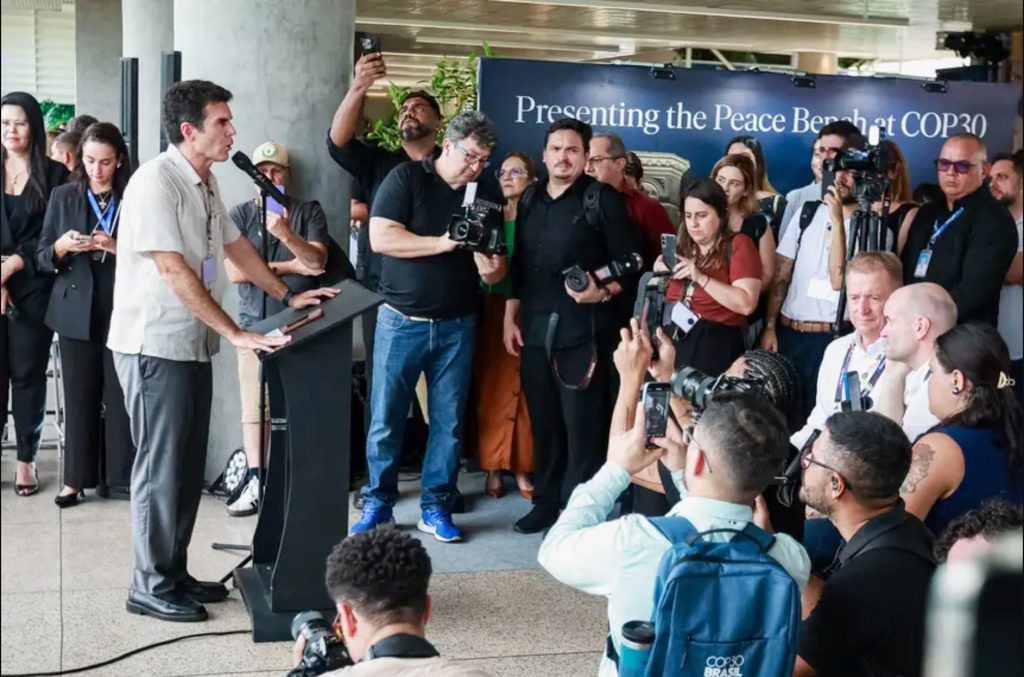
With the brand new Parque da Cidade as a backdrop, with its newly planted trees and vibrantly colored playground equipment, Barbalho signed an agreement in the Green Zone with Norway-based Hydro, a shareholder in Alunorte, the company alleged to be responsible for tailings leaks in the municipality of Barcarena. The agreement was aimed at cooperation on fighting fires and the opening of a Peace Bank. Made of aluminum, the project would represent “dialog as fundamental to resolving the world’s biggest challenges,” as explained by Kjersti Fløgstad, the director of the Nobel Peace Center, one of the initiative’s partner institutions, at the opening ceremony.
It would have been another scene in a Hydro advertisement, but someone forgot to tell Auricelia Arapiun, a leader in the Lower Tapajós. After Helder Barbalho’s speech on “social justice” and “environmental rights” for the peoples of the Amazon, she interrupted the ceremony and publicly asked the governor about the agreements with mining companies that have a major environmental and social liability in the Amazon: “Another project to destroy our lives,” the Arapiun people’s leader said.
The world of aluminum wasn’t all that fantastic for the people working in the Freezone. On the evening of November 20, while the COP30 president was reopening the Blue Zone after a fire had frightened everyone earlier in the day, workers were protesting in front of the Freezone about payments stipulated in their contracts not being made. Hydro and the Brazilian Aluminum Association, whose chairman of the board is Baranov, are some of the space’s biggest sponsors.
In a statement, Hydro said it “refutes any allegations of greenwashing,” adding that “all social and environmental information reported by the company is based on concrete and measurable goals.” In relation to environmental liabilities, the company said it is “not responsible for environmental damage in the municipality and there is no technical evidence that this has occurred.”
Auricelia is critical of decisions like the attempt to privatize the Tocantins, Madeira and Tocantins Rivers through a decree signed by Lula in August, which could hand the private sector more than 3,000 kilometers of Amazonian rivers to ensure that agribusiness has “more secure distribution” of its products. According to experts and local leaders, large vessel traffic is likely to cause serious social and environmental impacts. Again, the Forest’s peoples were not consulted, and Auricelia recalls this when she criticizes the conference being held in Belém. “Bringing the Indigenous peoples to take part is another type of washing, because we don’t sit at the negotiating tables to confront the climate,” she says.
Auricelia Arapiun looks to the future with worry. She is experienced in fighting for the rights of the peoples in the Lower Tapajós region and she notes the consequences these corporate washing actions over the last few days, with big campaigns and investments, will have on local peoples: “The bill for these mega-structures will come, and the one who’s going to pay isn’t Helder Barbalho, it isn’t the state government. We are the ones who will pay.”