FACING UP TO THE FINANCE SLAUGHTERING THE FOREST
How fighting money laundering can save the Amazon: Transnational Legal Coalition files eight complaints in four countries, focusing on the finance and supply chains of meatpacking giant JBS
Octávio Luiz Motta Ferraz, Carapitangui River, Maraú, Atlantic Forest – November 5, 2026
The drop in deforestation in the Amazon over the last four years is, without question, good news. Nevertheless, we have lost over 3,300 square kilometers of forest in just the last year, equal to 3.5 times the urban area of São Paulo, the city with the largest urban footprint in Brazil. Our strides continue to carry us, albeit more slowly, to the point of no return, a point when large areas of the Amazon are no longer a lush and humid forest and have become a much more arid biome with much less richness of biodiversity and disastrous consequences for local populations, regional rainfall patterns, and global heating, as noted by scientist Carlos Nobre. In light of this extremely worrisome scenario, a question arises: is deforesting the Amazon to raise cattle, which is by far the biggest cause of the Forest’s destruction, justifiable?
The answer is no. There is no rational or moral justification for trading one of the world’s most important biomes for pastures and meat. I imagine many other people, even those who would never turn their backs on their beloved grills, would agree. With so much area available in a country the size of Brazil, why raise cattle in the Amazon, 60% of which we have the enormous fortune of holding within our borders?
Beyond environmental vandalism, developing extensive livestock farming in the Amazon is a technological anachronism and makes no economic sense. Productivity is extremely low, oftentimes less than one head of cattle per hectare. Toppling a forest rich in biodiversity and potential biotechnology to replace it with a poor quality, low-yield pasture is a gigantic waste of natural capital.
And it is a model that sabotages agribusiness itself in the rest of Brazil, because the Forest works like a giant water pump, releasing the humidity into the atmosphere that forms so-called “flying rivers” which carry the rain that irrigates the fields of soybeans and corn in the Center-West region and far beyond. The severe and increasingly frequent droughts afflicting Brazil’s hydrographic basins are the visible symptom of this backward thinking.
Our environmental laws, some of the most advanced on the books, have also now reached this conclusion. The Constitution of 1988 elevated the Amazon to the status of a national heritage with special protections. We created no less than 430 conservation units and 378 Indigenous Territories for peoples who wisely conserve the Forest in this region. Since 1996, the so-called legal reserve area, which is the minimum amount of preserved area a rural property must maintain, has been set at 80% for properties in the Amazon. Deforesting beyond these limits is a serious administrative infraction, it is civilly unlawful, and it is an environmental crime.
Yet despite advances and massive efforts by government agents to ensure these legal protections are respected, the Forest, as we have seen, continues to be slaughtered at unacceptable levels. The political and material support needed to monitor the planet’s largest tropical forest will never be enough in the face of the economic incentives given to those who profit from its destruction. It is also therefore necessary to attack the problem from the demand side.
There are a variety of interesting initiatives in this area, such as stronger traceability of the chains supplying large meatpackers (including indirect suppliers) and the blocking of bank credit and financing for companies with environmental irregularities or those whose commercial partnerships have a high risk of illegal deforestation. It is in this last camp that the Transnational Legal Coalition, of which I am a founding member, is working.
We are using a simple strategy, but one that to this day is not widely employed: using the money laundering laws which began to spread around the world in the 1980s and have been enhanced in recent years. While they were initially focused on fighting drug trafficking and terrorism, today these laws apply to any crime, including environmental crimes, which are estimated to bring in up to 280 billion dollars annually worldwide.
Deforesting to illegally farm cattle in the Amazon constitutes a variety of criminal offenses under Chapter VI of the Brazilian Environmental Crimes Law (Law 9.905/1998) as well as under related laws in several countries around the world. Gaining financial benefit from cattle that is knowingly or suspected of being a direct or indirect product of crime constitutes money laundering in Brazil (Article 1 of Law 9.613/1998) and in many other countries. The combination of money laundering laws with environmental crime laws opens an excellent opportunity for us to put pressure on those who finance deforestation in the Amazon, and not just those directly perpetrating these crimes.
The Transnational Legal Coalition is doing precisely this, in partnership with the Articulation of Indigenous Peoples of Brazil (Apib). On November 5, 2026, we filed eight complaints1 with the competent authorities in four countries – the United Kingdom, Ireland, Germany, and the Netherlands – with evidence that money laundering laws were broken by 14 actors2 involved in the chain supplying and financing meat coming from deforested land in the Amazon. Two years were spent investigating to add to the evidence of illegal deforestation that has already been reported by other organizations since 2009, in addition to identifying financial backers.
In this initial work, we are focusing on the chains supplying and financing the largest meatpacker operating in the Amazon, JBS. With the support of Dutch non-governmental organization Aid Environment and using a conservative methodology, we found a scenario of devastation over the last 24 years in the zones of influence of the 21 meatpacking plants JBS operates in the Amazon biome. Forty million hectares of forest have been turned into pastures. This is larger than the entire country of Germany and 1.6 times the state of São Paulo. Of this total, we were able to reach a conservative calculation that at least 6.5 million hectares were deforested on properties held by direct (3,085) or indirect (6,127) suppliers to JBS, and another 11.3 million hectares were deforested within public lands in the zone of influence of JBS meat processing plants, indicating potential cattle laundering. What is worse is that we were able to identify a significant portion of this deforestation as having occurred inside of areas with special protections, such as permanent preservation areas, legal reserves, conservation units and Indigenous Territories.
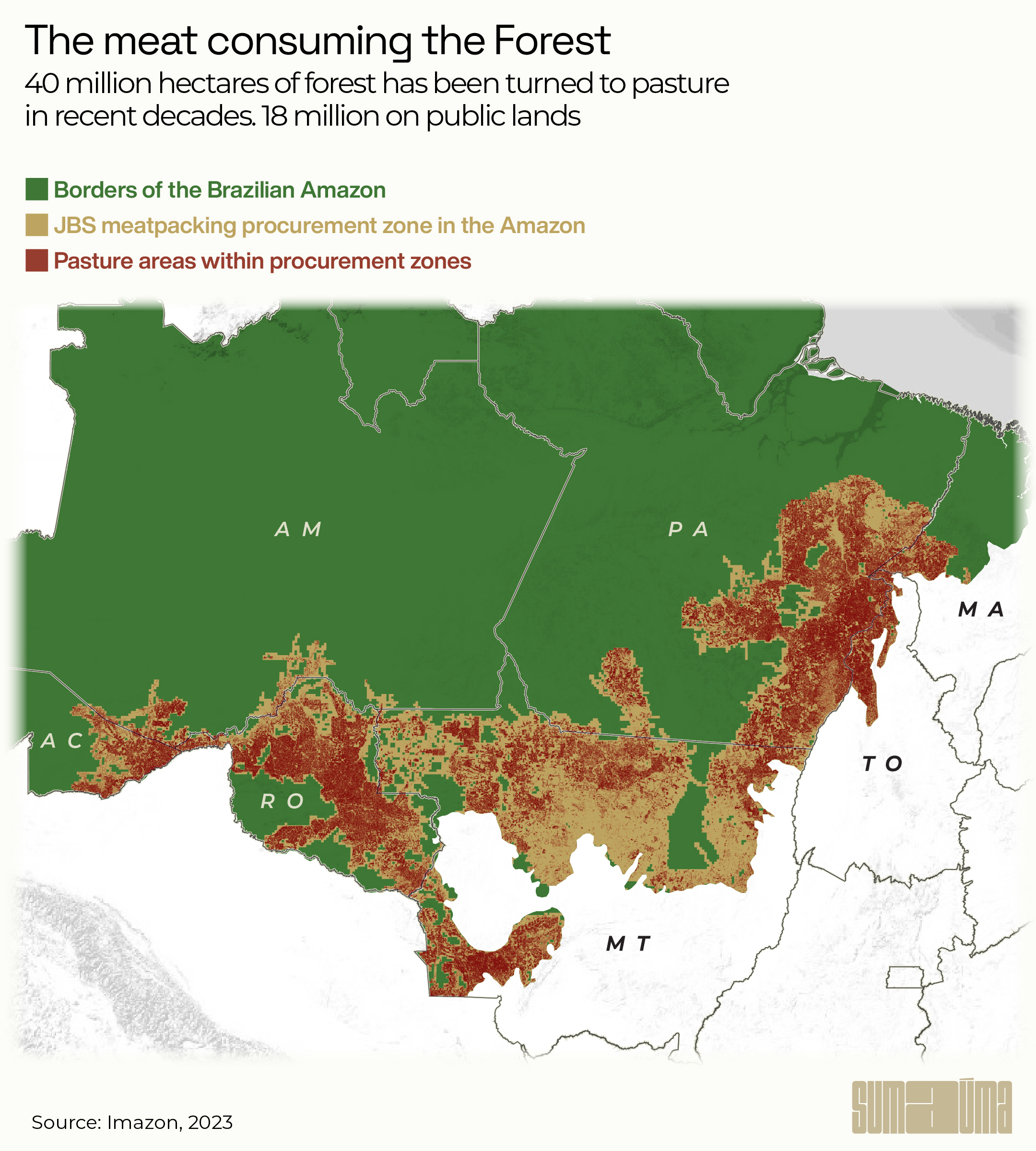
The Brazilian Amazon biome is shaded in green. Procurement zones for JBS plants in the Amazon are shaded in blue, and the pasture area within these procurement zones is shaded in purple. Source: Imazon, 2023
There is, therefore, sufficient evidence for JBS’s financial backers in the United Kingdom, Ireland, Germany, the Netherlands, and any other country to fulfill their due diligence, backed by money laundering laws, before they provide financing for the activities that are slaughtering the planet’s largest tropical forest. Being remiss from this duty means being complicit in devastation.
1Complaints were filed with the following eight agencies: United Kingdom: Financial Conduct Authority and National Crime Agency; Ireland: Central Bank of Ireland; Germany: BaFin Bundesanstalt für Finanzdienstleistungsaufsicht; and the Netherlands: De Nederlandsche Bank, Bureau Financieel Toezicht, Deken of the Amsterdam Bar; and The Openbaar Ministerie.
2In the United Kingdom: Barclays Bank Plc, Standard Chartered, Bank of Montreal (London Branch), Banco do Brasil S.A. (London Branch), BB Securities Limited, JBS Global (UK) Limited; in Ireland: BlackRock Asset Management Ireland Limited; in Germany: BlackRock Asset Management Deutschland AG; in the Netherlands: Rabobank, ING Bank, Loyens & Loeff, EY, KPMG, and JBS NV.
*Octávio Luiz Motta Ferraz is an attorney, an associate professor at King’s College London, and a founding member of the Transnational Legal Coalition